
From reporting to verification: understanding post-issuance trends in sustainable bonds


As the sustainable bond market matures, the challenge is shifting from accessing data to interpreting it. Attention is moving away from issuance volumes towards the quality, transparency and credibility of post-issuance practices.
Drawing on insights from the LGX DataHub – which includes over 200 data points on more than 25,000 sustainable bonds from over 4,200 issuers worldwide – this article explores key trends in reporting coverage and external verification observed from 2019 to January 2026.
An analysis based on data from the LGX DataHub shows that 89% of bonds issued before January 2023 have post-issuance reporting. The data also highlights a positive correlation between the age of issues and the coverage rate of post-issuance reporting.
As of 31 January 2026, the coverage of post-issuance reporting increases with the age of the bonds, reaching 60% for issues from late 2024 and around 89% for those prior to January 2023. This trend suggests that the majority of issuers publish their reports around the 12th month after issuance, in line with ICMA recommendations.
However, practices remain variable: some bonds are reported as early as 6 to 9 months after issuance, whilst others are only covered after 18 to 24 months, or even later.
Regional differences remain visible, reflecting variations in standardisation and market expectations, although all markets show strong participation. Reporting coverage ranges from 76% to 94%, with supranational issuers and Europe leading, likely reflecting the European Union’s comprehensive green bond regulatory framework, while South America records comparatively lower levels.
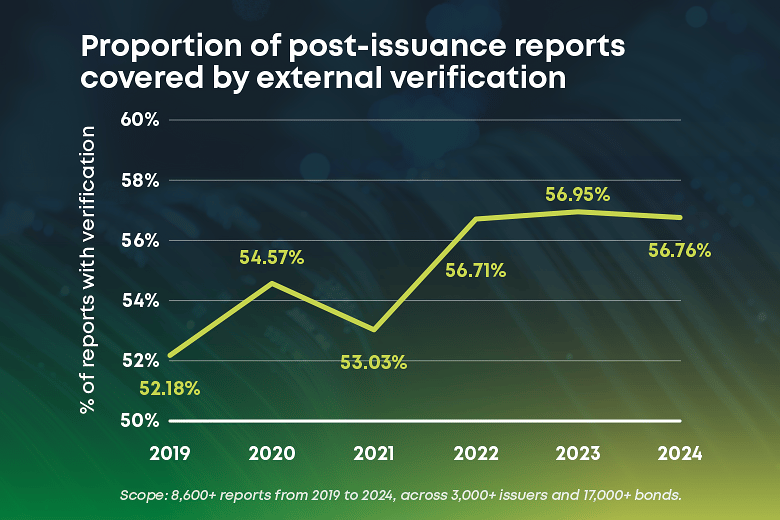
On that front, data from the LGX DataHub for 2019-2024 shows progress with a slight upward trend in the verification coverage – but still limited, with just over half of reports of sustainable bonds verified externally during this period.
Drawing on insights from the LGX DataHub – which includes over 200 data points on more than 25,000 sustainable bonds from over 4,200 issuers worldwide – this article explores key trends in reporting coverage and external verification observed from 2019 to January 2026.
The growing role of post-issuance reporting
Post-issuance reporting is a key driver of transparency, enabling the allocation of raised funds to be documented and, in some cases, the impact of the projects financed. It therefore plays a central role in monitoring the commitments made by issuers, whilst enhancing the credibility of sustainable issues and investor confidence.An analysis based on data from the LGX DataHub shows that 89% of bonds issued before January 2023 have post-issuance reporting. The data also highlights a positive correlation between the age of issues and the coverage rate of post-issuance reporting.
As of 31 January 2026, the coverage of post-issuance reporting increases with the age of the bonds, reaching 60% for issues from late 2024 and around 89% for those prior to January 2023. This trend suggests that the majority of issuers publish their reports around the 12th month after issuance, in line with ICMA recommendations.
However, practices remain variable: some bonds are reported as early as 6 to 9 months after issuance, whilst others are only covered after 18 to 24 months, or even later.
Regional differences remain visible, reflecting variations in standardisation and market expectations, although all markets show strong participation. Reporting coverage ranges from 76% to 94%, with supranational issuers and Europe leading, likely reflecting the European Union’s comprehensive green bond regulatory framework, while South America records comparatively lower levels.
Beyond reporting – verification as a sign of credibility
While reporting signals transparency and enables impact measurement, external verification is crucial, as it ensures that sustainable bond proceeds reach the intended projects made public by the issuer, and for sustainability-linked bonds (SLBs), that reported KPIs are accurate – ultimately strengthening the issuer's credibility and investor confidence.On that front, data from the LGX DataHub for 2019-2024 shows progress with a slight upward trend in the verification coverage – but still limited, with just over half of reports of sustainable bonds verified externally during this period.