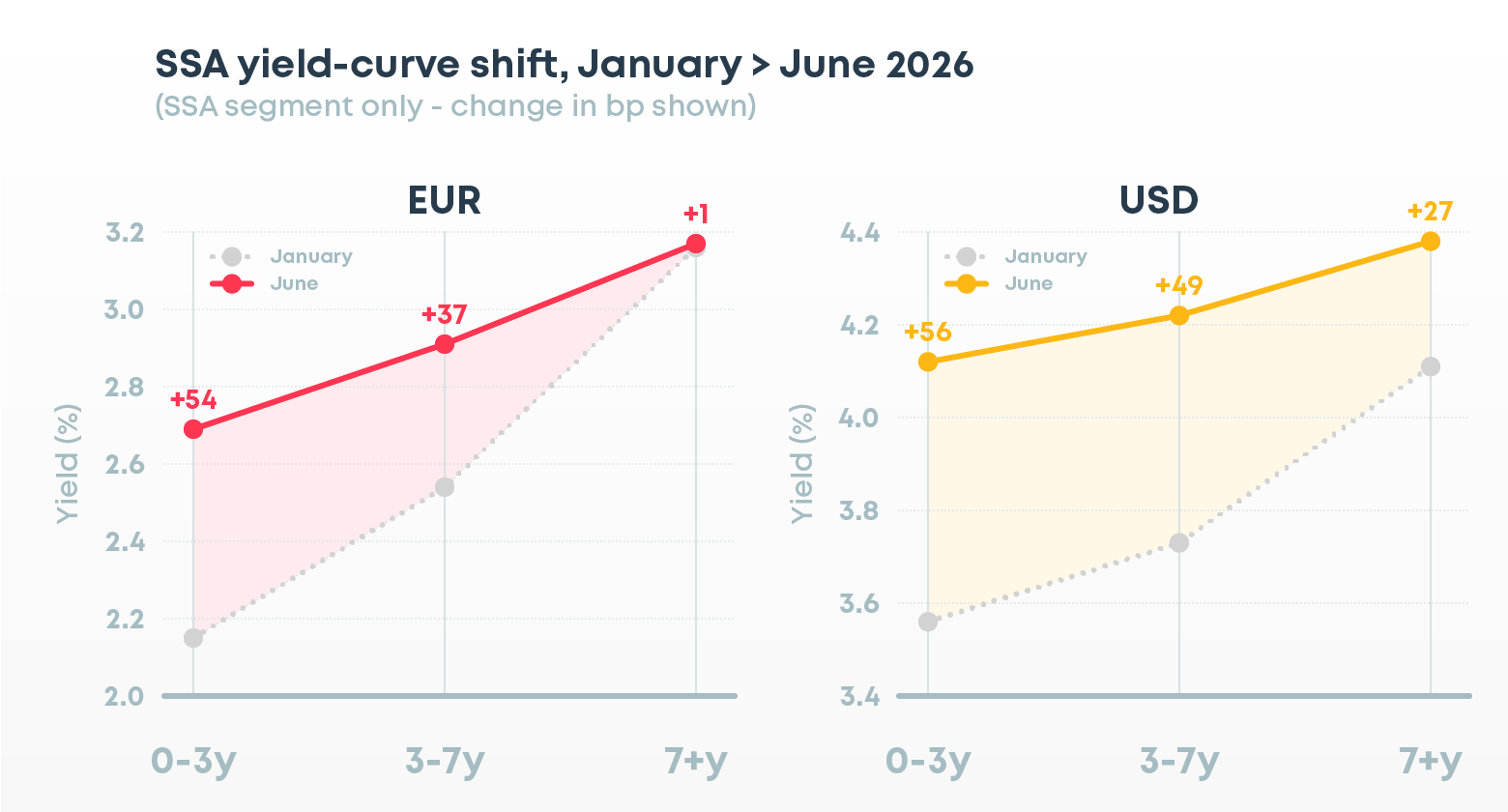
SSA yields, January versus June - the highest-quality, government-linked segment, and our closest benchmark-like curve (though not a pure government one). In euros the long end (7y+) barely moved (+1 bp) while the short end jumped; the dollar curve rose front-first too, but flattened far less (long end +27 bp)
The dollar side: resilience amid a hawkish Fed
The Fed kept its policy rates unchanged throughout the first half of the year, at 3.50%-3.75%, but its tone became more hawkish in June. At its June meeting, it once again left rates unchanged - by a unanimous 12-0 vote - yet its updated forecasts signaled a more restrictive path ahead: officials now see the fed funds rate ending 2026 at 3.8%, up from 3.4% in March.
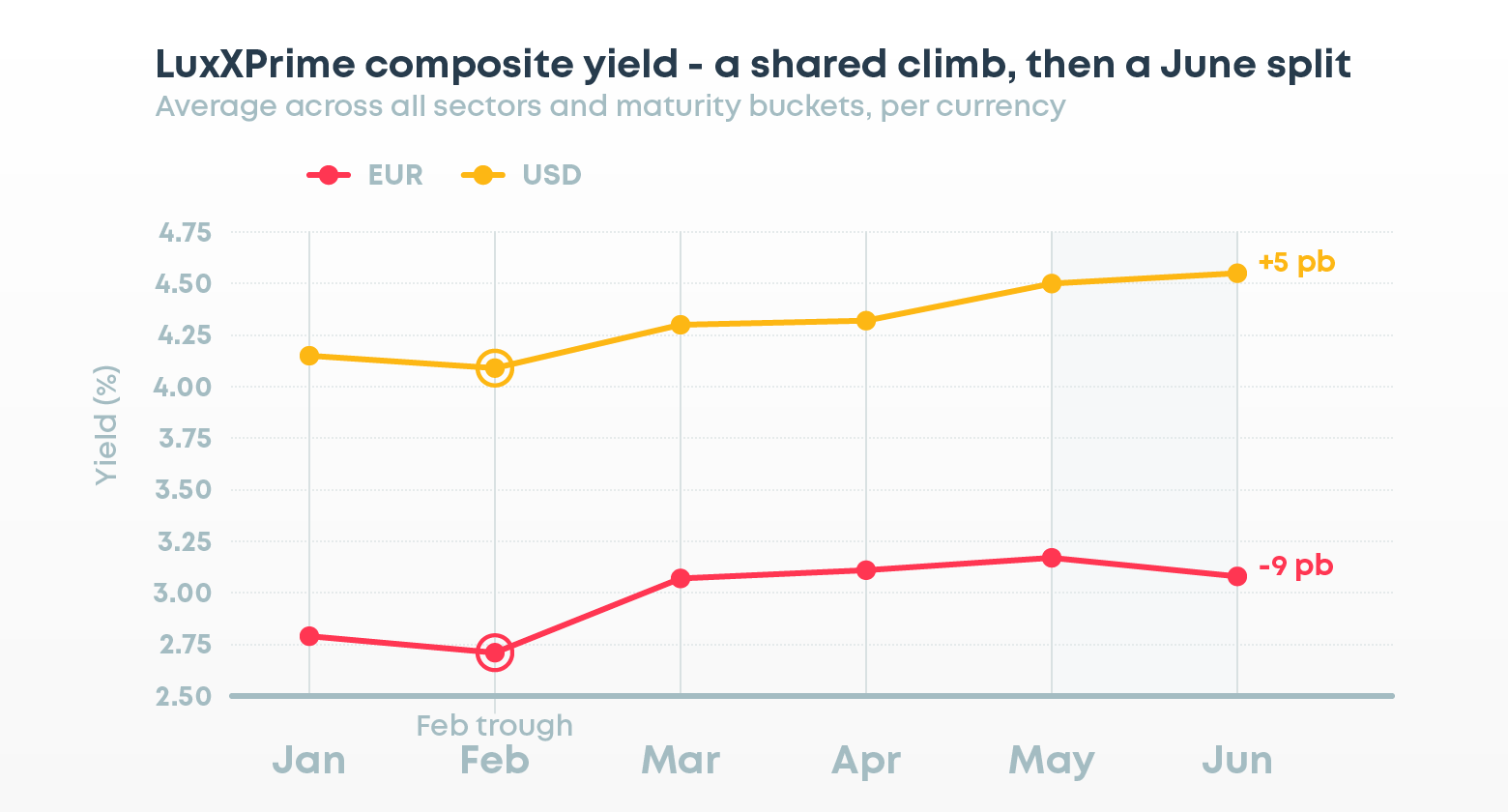
That gave the dollar additional support, even as oil prices fell. While euro yields declined, dollar yields remained firm. Across the half, our dollar bonds followed the same short-end-led pattern as euro bonds, although the adjustment was more gradual. This mirrored broader market developments: German 10-year Bund yields rose over the spring, while short-dated US Treasury yields moved sharply higher following the Fed's hawkish shift.
Why dollar bonds still offer higher yields
Dollar yields sit roughly 120-150 basis points above euro yields in our data - essentially the central-bank rate gap showing through (the Fed near 3.6%, the ECB at 2.00% for most of the half). It narrowed in spring as euro yields caught up, then widened again in June, to about 147 basis points. But that extra yield isn’t free: for a euro investor, a dollar bond carries currency risk unless hedged, and hedging costs can eat up much of the pickup.
The short end led the move
The rise wasn’t even. In both currencies, short-dated yields moved much more than long-dated ones - the gap between long and short yields shrank from about 101 to 48 basis points in euros, and from 55 to 26 in dollars. Bond by bond, none of the longest maturities (7y+) featured among the six biggest movers, and the four smallest moves are all at the long end.
That fits what both central banks face: inflation and tighter policy push short yields up, while growth worries cap long yields. The usual order held - Financials paid most, then Corporates, then SSA - and by June the Financials-over-SSA pickup was about twice as large in dollars as in euros (roughly 63 versus 31 basis points). That’s not a clean read on credit, though: it would need to be adjusted for maturity, issuer mix and trading. Still, investors wanted more compensation for risk without pricing in significant credit deterioration.
What it means for an investor
The takeaway: this was a global move in rates, not something unusual about LuxXPrime, and higher yields mean more income - but not less risk. Short bonds led because the move was about expectations for the future path of rates. Shorter-dated, high-quality euro bonds may look more appealing than earlier - offering more income and less exposure to rate swings than long bonds. The dollar’s extra yield, and the higher pickup on Financials, each carry their own risks - currency, credit, sector and liquidity - rather than representing a risk-free premium.
None of this changes how LuxXPrime trading works, but it provides important context: our yields moved because the global price of money was being reset in real time. The half year ends at a turning point - the energy shock easing as oil falls back, the euro stabilising after its rate rise, and the dollar still grinding higher. Whether June was a real turn or just a pause is for the second half to answer.